 HouseChores
A printable chore chart
A blank week to fill in by hand, a worked example if you would rather start from something, and a rotation for the jobs nobody volunteers for.
Print straight from this page — Ctrl + P, or Cmd + P on a Mac. The menus, links and buttons drop away; the charts stay, sized to write on.
The blank week
Names across the top, jobs down the side. Seven of each is usually more than a household needs — cross out what you do not use.
| Job | Mon | Tue | Wed | Thu | Fri | Sat | Sun |
|---|---|---|---|---|---|---|---|
A filled-in example
Three people, one week. Not a template to copy exactly — a shape to argue with.
| Job | Mon | Tue | Wed | Thu | Fri | Sat | Sun |
|---|---|---|---|---|---|---|---|
| Dishes | Sam | Alex | Jo | Sam | Alex | Jo | — |
| Kitchen clean | Jo | ||||||
| Bathrooms | Sam | ||||||
| Vacuum | Alex | ||||||
| Sheets & laundry | Jo | ||||||
| Bins out | Alex | ||||||
| Shop & plan week | Sam |
Notice what is missing from that chart. Nobody is written down for noticing the washing powder is nearly out, or for remembering the dentist. That work is real, it takes time, and a chart that leaves it off quietly assigns it to whoever notices first — usually the same person, every week.
If you write only one invisible job onto your chart, make it "plan the week". It is the one that makes all the others possible.
A rotation for the jobs nobody wants
Some jobs are genuinely worse than others. A rotation stops them landing on the same person every week without anyone having to argue about it.
| Week | Bins | Bathroom | Kitchen deep clean |
|---|---|---|---|
| Week 1 | Sam | Alex | Jo |
| Week 2 | Alex | Jo | Sam |
| Week 3 | Jo | Sam | Alex |
| Week 4 | Sam | Alex | Jo |
Making a paper chart actually work
- Put it where people already look — the fridge, the back of the door, beside the kettle. A chart in a drawer is a chart nobody reads.
- Fill it in together the first time. A chart handed down gets ignored; a chart argued over gets followed.
- Leave the marker next to it. The friction of finding a pen is enough to stop the ticking, and an unticked chart stops being true within a week.
- Redo it when life changes, not when it gets messy. New job, new term, someone away — that is when the old chart stops fitting.
- Expect it to go stale. Paper cannot tell you what got missed last week, and it cannot move a job when someone has a bad week. That is the honest limit of a chart on a fridge.
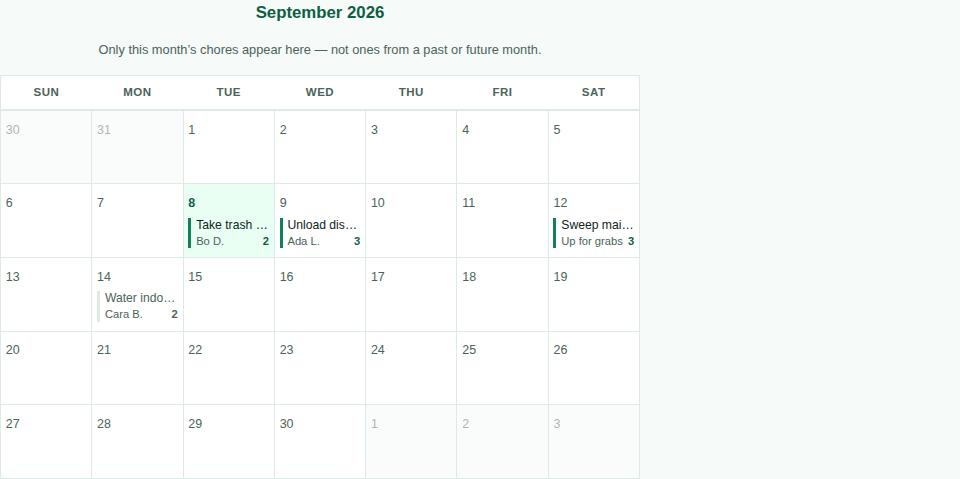
A paper chart is a snapshot; it stops being right the moment the week changes. HouseChores is the same idea on a screen the whole household reads — chores distributed by what each person can carry, ticked off as they are done, and repeating on the rhythm you set. Free, with no ads and no trackers.